The problem
Teachers in the Horn of Africa spend their evenings writing lesson plans by hand and marking stacks of homework. Generic AI tools don't help much: they don't know the national curriculum, they invent content that isn't in the textbook, and they don't speak the words pupils have actually been taught.
What Layli does
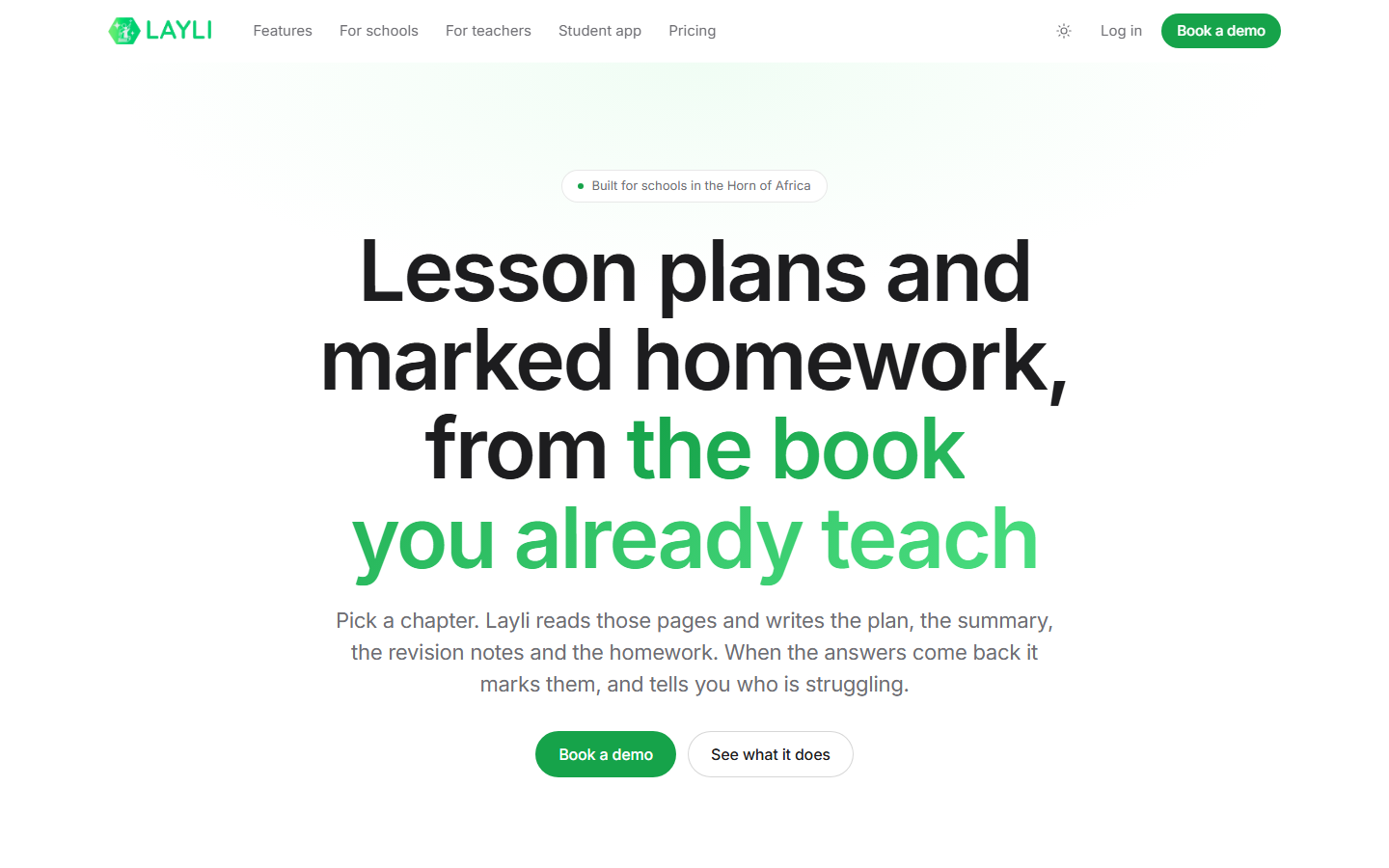
Layli works from the book the class is already holding. A teacher chooses the grade, subject, chapter and page range from the school's library, and Layli reads those pages to write exactly what's needed:
- Lesson plans for the chapter about to be taught
- Summaries and revision cards that cut a chapter down to notes and questions
- Homework sets that go straight to a class, with no queue at the photocopier
- AI marking of written answers as well as multiple choice, with a note on what each pupil missed
The teacher stays in charge: everything Layli writes is a draft, and no mark reaches a pupil until the teacher approves it.
One loop, many views
Planning, homework, attendance and reports all read the same class lists and the same curriculum library. A register taken in the morning lands in the term report by itself, and homework scores feed the class and school dashboards without anyone typing them up. School leaders see marks by class and teacher, syllabus progress and attendance they can export when the ministry asks.
The student side: Caalim
Whatever a teacher assigns shows up in Caalim, the student app, free for every pupil. Students read the summary, answer the questions and get their marks back the same evening. Caalim has 20,000+ downloads and a 4.5 rating on Google Play.
Built for the region
- Supports the Somaliland, Puntland, Somalia, Edexcel and international curricula, across 50+ subjects
- The teacher platform runs in Somali and English
- STEM simulations for physics, chemistry and biology, for schools without a working lab
- A school can be running in an afternoon: classes import from the spreadsheet it already keeps